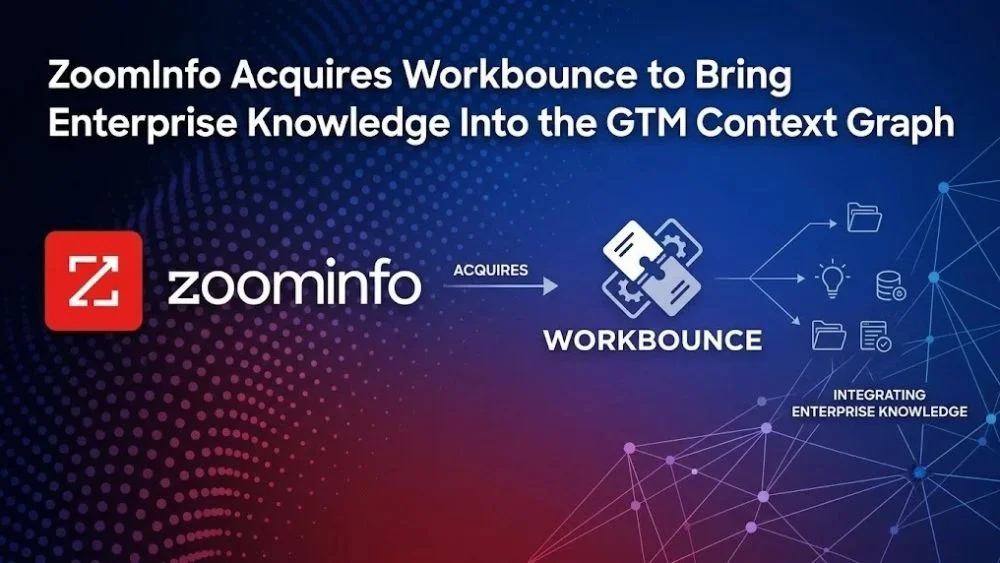
ZoomInfo has expanded its GTM.AI platform with the addition of the ZoomInfo Workbounce acquisition, which brings enterprise knowledge into its GTM Context Graph. The company said the enhanced capabilities will be available by Oct. 14, 2026. ZoomInfo (NASDAQ: GTM) provides an all-in-one, AI-Powered go-to-market platform. Workbounce is a knowledge platform for unstructured go-to-market information. The company was co-founded by Rowan Bailey and Adam Smith and was bought by ZoomInfo in 2024.
The integration adds a layer of semantic knowledge to the GTM Context Graph. Consequently, ZoomInfo can combine trusted market intelligence with the data that resides in enterprise tools. You can pull in call transcripts, emails, presentations, product docs, account notes, Slack threads, Google Drive folders and Notion pages.
Previously, ZoomInfo’s GTM Context Graph was mostly driven by verified structured data. This information includes companies, contacts, business relationships and buying signals. But sales teams also count on internal knowledge contained in various systems. This leads to sellers and AI agents to often have trouble accessing relevant information in a consistent manner.
Workbounce solves this challenge by combining internal enterprise knowledge with GTM.AI. Thus, AI agents can use external market intelligence and internal company information. This can enable more personalized, context-aware and relevant customer interactions.
ZoomInfo Founder and CEO Henry Schuck explained the strategic importance of this development.
“There are three context graphs inside every organization; corporate search, engineering, and product. The Workbounce acquisition powers our ability to deliver the GTM Context Graph across this unstructured data that is critical to GTM teams everywhere,” said Henry Schuck, Founder and CEO of ZoomInfo.
“ZoomInfo gives GTM.AI the verified structured data needed to understand the market. Workbounce adds the institutional knowledge inside your own walls. When those two layers come together, an agent can understand both the market and the account, with provenance, permissions, and confidence built in.”
Structured Data Meets Institutional Knowledge
GTM.AI uses verified grounding data, the unified identity and ZoomInfo’s GTM Context Graph to create go-to-market workflow skills. Workbounce, meanwhile, takes this foundation and applies it to unstructured enterprise knowledge. Workbounce allows companies to ingest, search and analyze their proprietary information within GTM.AI. It marries this knowledge with ZoomInfo’s market intelligence in a shared trust framework. The input can also contain lineage, confidence and entitlement controls. These safeguards enable AI agents to tap into relevant information while preserving enterprise governance requirements.
ZoomInfo also pointed out the results of its GTM Bench v1 assessment . In the evaluation we compare its command line interface (CLI) and Model Context Protocol (MCP) to two competitors. It also measured web search across 10 research tasks . ZoomInfo’s MCP had the highest verified work-email coverage at 94 percent, ZoomInfo says. Furthermore, the ZoomInfo CLI was more efficient in terms of the number of work tokens used in the evaluation. CLI used 460,000 tokens in a Claude Opus 4.8 run. For comparison, web search used 11.1M tokens.
The evaluation also timed how long the tasks took to perform. MCP completed the tasks in 32 minutes, whereas the web search took 102 minutes. The results demonstrate the reported efficiency of structured market data in AI workflows. But structured information alone won’t solve every sales problem. Teams need to understand the context of previous customer conversations, account history, and internal discussions. Workbounce brings this proprietary context into agent workflows directly.
For example, sales reps can go back and reconstruct account histories on closed-lost opportunities. They can go back and listen to previous calls and find materials that relate to specific questions the buyer has. Hence AI agents can access information that verified market data cannot provide on its own.
Workbounce Adds a Semantic Knowledge Layer for Sales Teams
Workbounce is a search, collaboration, and analytics tool built specifically for sales teams. It serves as a single point of access for documents, conversations, and customer data. Thus, representatives are able to gain access to information which helps them build relationships with clients. Workbounce integrates with other business tools such as call recordings, email, and Google Drive. It makes all this information available using semantic search. Semantic search differs from regular keyword search by being based on meaning.
Thus, sales teams can find relevant answers, documents and account information more effectively. They will also decrease their reliance on memory and incomplete information sources of individual employees.
ZoomInfo uses Workbounce to support sales activities in GTM.AI.
First of all, it increases efficiency of answer and asset retrieval. Sales reps and AI agents can easily find all the necessary material, conversations and internal information. This feature will allow representatives to better prepare for customer engagement.
Secondly, Workbounce can decrease amount of administrative effort. Sales reps will not have to search for information across various systems and recreate history of the account. Moreover, they will be able to reduce efforts related to customer preparation. Thirdly, it allows for next-best-action suggestions. Workbounce can recommend relevant assets and messages to advance sales opportunities. Thus, representatives will be able to use information to make next actions in their processes.
Fourthly, Workbounce allows for collaborative customer spaces. It can enhance knowledge exchange between vendors and clients while workflows are developing.
Adam Smith, Vice President of Product Management at ZoomInfo, described the thinking behind Workbounce and its integration.
“Workbounce was built on a simple belief: a team’s most valuable knowledge is often its most scattered,” said Adam Smith, Vice President, Product Management at ZoomInfo. “ZoomInfo has the trusted structured data layer for go-to-market. By bringing Workbounce into GTM.AI, agents can ground their answers in both external market truth and everything the team already knows, exactly when that context is needed.”
In doing so, ZoomInfo is able to integrate their market intelligence data with institutional knowledge. The enhanced GTM Context Graph will integrate the aforementioned information within the AI-enabled sales workflows. As businesses integrate their AI agents to go to market activities, the need for internal and external context remains essential.
Thus, the Workbounce acquisition of ZoomInfo further enhances the capabilities of GTM.AI to enable enterprise sales operations. Integrating the structured market intelligence with institutional knowledge will enable agents to make more meaningful answers and recommendations. Also, the governance capabilities of the platform cater to enterprise needs.
In essence, the integration is an extension of ZoomInfo’s efforts in enabling AI-enabled sales intelligence. It integrates information which was previously siloed into various business applications. Thus, the sales teams have the chance to leverage a more integrated base of information in order to engage with customers.
Looking for more updates on financial innovation and revenue-driven technology? Visit RevTech News for expert insights and the latest trends.
News Source: Businesswire.com