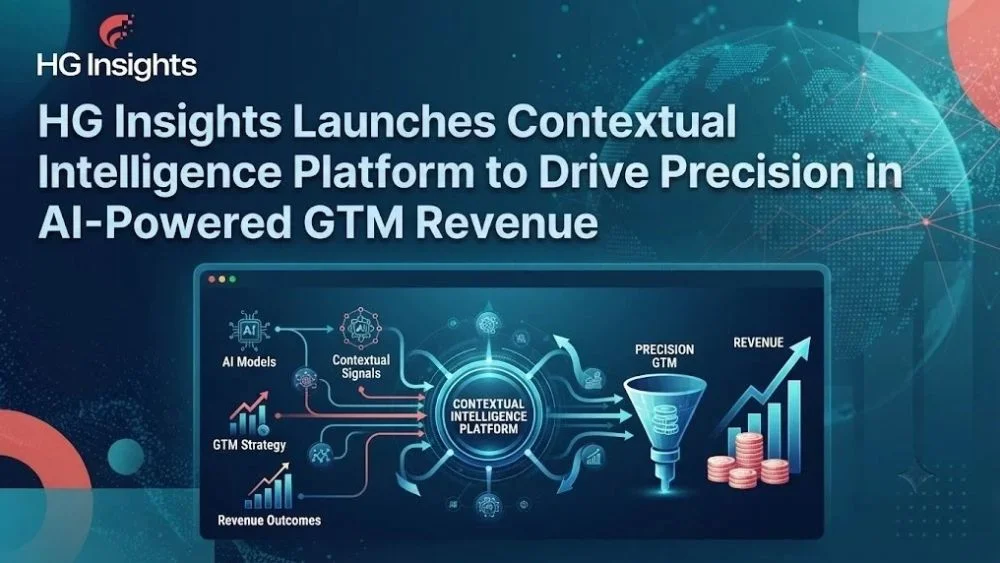
HG Insights Introduces Contextual Intelligence Platform to Fill Critical Gaps in AI-Driven GTM Operations The new platform brings together markets, accounts, buyers and revenue intelligence into a single environment. This, in turn, allows GTM teams to make faster, more informed decisions. It was first launched on October 6, 2026. It also reveals a new HG Insights brand personality. The reimagined identity reflects the company’s evolving position in the growing AI-powered GTM market.
Connects autonomous AI agents to connected and decision-ready intelligence. Contextual Intelligence Platform So agents can operate with additional context within complex GTM workflows. That intelligence can also be leveraged by teams to identify opportunities and accelerate pipeline growth.
“Every GTM team is adding the same agents, the same tools, the same playbooks. When the infrastructure is equal, whoever knows the account best wins,” said Rohini Kasturi, CEO of HG Insights. “Most vendors still sell disconnected data and call it intelligence. We’ve built the intelligence layer for autonomous, agentic GTM. Our platform connects the data, gives it context, and derives decision-ready signals that power teams and AI agents to execute with precision.”
Context Gives AI Agents Better GTM Intelligence
AI agents are rapidly becoming a standard tool in enterprise GTM operations. But the output they put out is extremely dependent on the intelligence behind them. Businesses need data that is complete, accurate and connected. Many GTM agents are still using fragmented internal and commodity data sets. Those datasets often lack the entity resolution that is needed for accurate analysis. This means the same company can be listed as several separate accounts.
This fragmentation can also distort the information on expenditure. Subsidiary technology spending could be recorded under the wrong parent company. It can also be completely hidden from an account view. Buyer intent signals can also lead to wrong conclusions. There could be a new business opportunity in an existing customer. A competitive account can also seem like an immediately winnable prospect.
The marketing and sales teams may face the challenge of relying on job titles instead of actual purchasing responsibilities. This would inhibit proper accuracy of buyer intelligence and account information. Without context, the AI can make firm yet wrong recommendations. In addition, errors can be compounded by automation in the end-to-end process.
HG Insights addresses this issue through its Contextual Intelligence Platform. The platform connects technology installations, usage, spending, and buyer intent. It also connects buying centers and contacts with account structures. The platform tracks these changes over time. It then generates signals that individual data sources cannot provide alone. Consequently, teams can better identify opportunities and prioritize accounts.
Teams can also combine this intelligence with their own first-party customer data. This approach provides deeper context for GTM execution. It helps businesses distinguish opportunities and prioritize leads with greater precision.
“Account data still lives across a dozen separate systems inside most organizations, and that fragmentation matters even more as agentic autonomy increases and agents become embedded within GTM workflows. Accurate account and contact resolution, combined with comprehensive buyer context, determines whether an agent can reason effectively and take actions that drive pipeline growth. Contextual intelligence will drive GTM outcomes and deliver compounding value as the agents and applications on top of it evolve,” said Michael Levy, analyst at GZ Consulting.
New Capabilities Across the HG Insights Platform
HG Insights has released a number of platform updates. Improve data intelligence, sales execution and GTM automation. Fabric is the backbone of the platform’s data and intelligence. Now it covers companies, technologies and spend more extensively. The system adds funding and M&A intelligence as well. Corporate hierarchies are updated automatically by Fabric. It also matches contacts to buying centers for particular technologies. The platform is also adding a new signal, Momentum.
Momentum signal indicates if a vendor, portfolio or product is gaining or losing ground. This allows GTM teams to detect shifts in competitive landscapes. For example, a declining footprint, spending and intent may be a sign of competitive displacement. In contrast, growth in these areas can be seen as stronger competitive momentum.
Customers can license fabric separately. They can get the data via API or Direct Feed as well. The platform can connect with data warehouses, CRM systems, applications and models. HG Copilots Data Studio Sales Copilot Market Analyzer Such tools allow teams to analyze markets and enhance account coverage. They’re also helping with audience development and buyer engagement.
Sales Copilot is now aligned to customer-specific products, buyers and sales motions. A sales rep can build a ranked account list based on detailed research. The list may also include engagement history and intent signals. Sales Copilot also gives suggested sales plays and product pitches. It also identifies the key contacts within buyer committees. Each recommendation is accompanied by a clear rationale to improve transparency. HG Copilots also brings transparency to predictive AI scoring. Fit, Need and Intent models are updated on the fly. They are still deterministic, explainable and adjustable.
HG Agents Automate GTM Workflows
HG Agents automate many time consuming GTM activities. They include sizing for expansion, territory coverage, and research on accounts. They also track signals and help build briefs. The agents can write outreach and do data enrichment. In the past, these activities required a lot of manual research and analysis. HG Agents is accessible to users through Slack and Microsoft Teams. They can also use the HG interface . The agents can be embedded into the own application of the business by means of standard Model Context Protocol (MCP).
HG Insights has also introduced HGSuperagent. The system interprets user requests and selects appropriate specialist agents. It then combines their outputs into a single response. Each claim includes a source citation. Therefore, users can review the information supporting the result. An account research brief can deliver more than 30 data points within 90 seconds. As a result, GTM teams can expand coverage across larger territories. Teams can move beyond only their highest-priority accounts.
HG MCP Server provides another access point to HG’s contextual intelligence. Customers can connect AI agents and applications without building separate data infrastructure. Through one secure connection, users can access market, account, and buyer intelligence. They can also access TrustRadius product reviews and SEC filings. The system also supports federal contract data and live web research. In addition, customers can use curated workflows for different GTM requirements.
Users can trigger and monitor HG Agents through the same environment. They can also query Fabric for custom analysis and market sizing. Other applications include ICP segmentation, ABM, and campaign design. Every result traces back to its source data. This approach allows users to verify the information behind GTM decisions.
Customer Voice Strengthens Buyer Intelligence
Customer Voice, from TrustRadius, expands the platform’s buyer intelligence. It adds buyer-intent signals downstream to Fabric. The TrustRadius community consists of more than 12 million technology buyers. These buyers are active researchers of products and technology solutions.
Customer Voice also supports customer verified reviews and ratings. These resources can boost social proof and SEO performance. In addition, the solution is AI citeable and GEO monitorable. Vendors can monitor their presence across AI search experiences.
HG Insights Expands Its AI Ecosystem
HG Insights is extending its Contextual Intelligence Platform across the enterprise AI ecosystem. Customers do not need to move their data to use the platform. They also do not need to rebuild existing workflows. Additionally, businesses do not need to standardize on one AI platform. Fabric, HG Copilots, and HG MCP Server are available through AWS Marketplace. This availability can simplify procurement for eligible customers. It also allows eligible businesses to apply existing cloud commitments toward HG Insights.
HG MCP Server brings HG intelligence into Amazon Quick, Anthropic, OpenAI, and Microsoft. Modern enterprises increasingly use multiple models and AI platforms. Different teams may also use different interfaces. However, their GTM intelligence can remain consistent. HG Insights separates the intelligence layer from the interface. Therefore, different teams can work from the same market and account information.
An analyst can work through Microsoft. A GTM engineering team can build with OpenAI. Meanwhile, sales representatives can use HG Copilot. All these users can access the same connected view of markets, accounts, and buyers.
Pricing and Availability
October 6, 2026 The Contextual Intelligence Platform is released. The offering comprises Fabric, HG Copilots, HG Agents and HG MCP Server. HG Insights has a consumption-based pricing model for the platform. The model is Intelligence Credit-centric. The approach provides customers flexibility as they adopt contextual intelligence. It also allows for scalability and more control across varying GTM needs.
The cost for HG Copilot modules is $22,000 and up. There are other packages available depending on your enterprise requirements. Complete pricing information is available by contacting HG Insights. They can also visit hginsights.com for additional information.
Looking for more updates on financial innovation and revenue-driven technology? Visit RevTech News for expert insights and the latest trends.
News Source: PRNewswire.com