
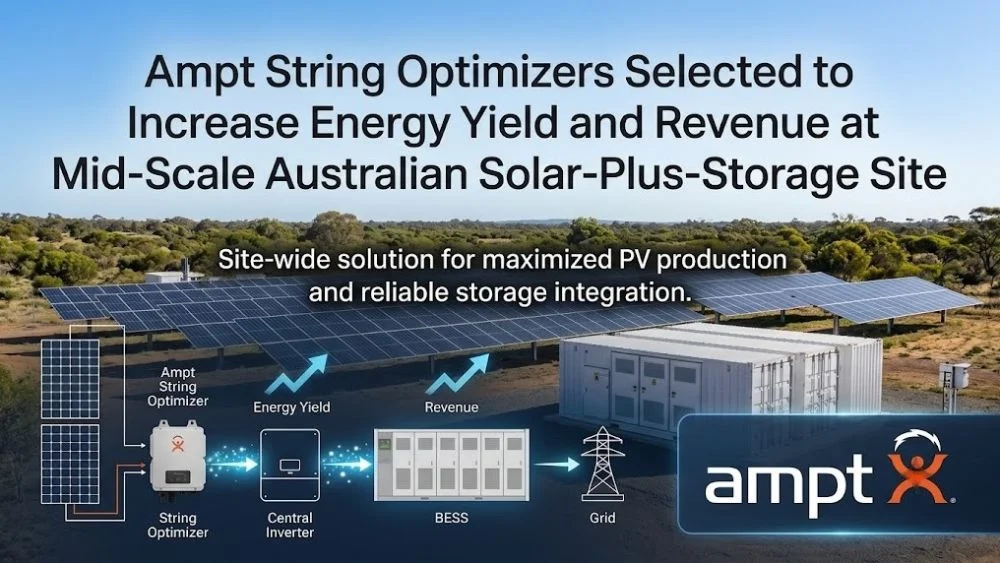
Leading DC optimizer provider, Ampt, today announced a project win. Its Ampt string optimizers will be deployed in a mid-scale solar-plus-storage project in Victoria, Australia. The project will employ Ampt’s battery-centric Direct-to-Battery (D2B) architecture. The result is lower CAPEX, higher lifetime energy yield, and the rapid grid response required by Australia’s grid services markets. The project also mirrors the country’s growing focus on mid-scale solar-plus-storage as part of its clean energy transition.
The PV array is directly connected to the common dc bus between the battery and battery inverter in the D2B architecture. This is possible due to Ampt String Optimizers. Consequently, developers do not need to buy costly equipment such as central DC/DC converters, PV inverters and transformers. The start-up costs are therefore less. This architecture also cuts down on the costs of electrical wiring.
Ampt optimizers, in addition, increase system production and revenue. These reduce electrical mismatch losses from module degradation. Other sources of imbalance are also considered, e.g. temperature, shading and soiling.
The system Ampt string optimizers combined 8.2 MWdc of solar generation with 4.95 MWac of power conversion capacity. It also has 20 MWh in battery storage. Ampt’s D2B architecture provides the fast grid response required for contingency Frequency Control Ancillary Services (FCAS) markets. So, the project may be included in those markets. This participation adds to the grid stability. At the same time it gives the developer another stream of revenue.
“Local communities are the true winners of mid-scale solar systems by having renewable energy closer to where they live and work,” said Russell French, Country Director for Australia at Ampt. “By deploying distribution-connected mid-scale systems directly into the existing local grid, close to where power is consumed, developers add renewable energy capacity while reducing the need for costly infrastructure upgrades. When battery storage is co-located with mid-scale solar, these hybrid systems can capture excess daytime generation and dispatch it during the evening peak, helping stabilize the local network rather than overloading it.”
Australia Backs the “Missing Middle” of Its Energy Transition
Australia cranks up the volume on mid-scale renewables connected to distribution and Ampt has been selected. In August 2026, the Clean Energy Finance Corporation (CEFC) invested $100 million in the Distribution Connected Accelerator Program (DCAP). The financing initiative is aimed at accelerating hybrid solar and battery projects up to 5 MWac. The CEFC has identified this part of the market as the “missing middle” between residential and large-scale solar.
With 4.95 MWac of inverter capacity, the Victoria project matches the scale the initiative targets. Likewise, it offers a blueprint for similar projects to follow.
Finally, Ampt string optimizers the project builds on Ampt’s experience with multi-hundred-megawatt DC-coupled solar-plus-storage systems. It also demonstrates how the D2B architecture helps developers maximize the value of both large and mid-scale hybrid projects.
Looking for more updates on financial innovation and revenue-driven technology? Visit RevTech News for expert insights and the latest trends.
News Source: PRNewswire.com